
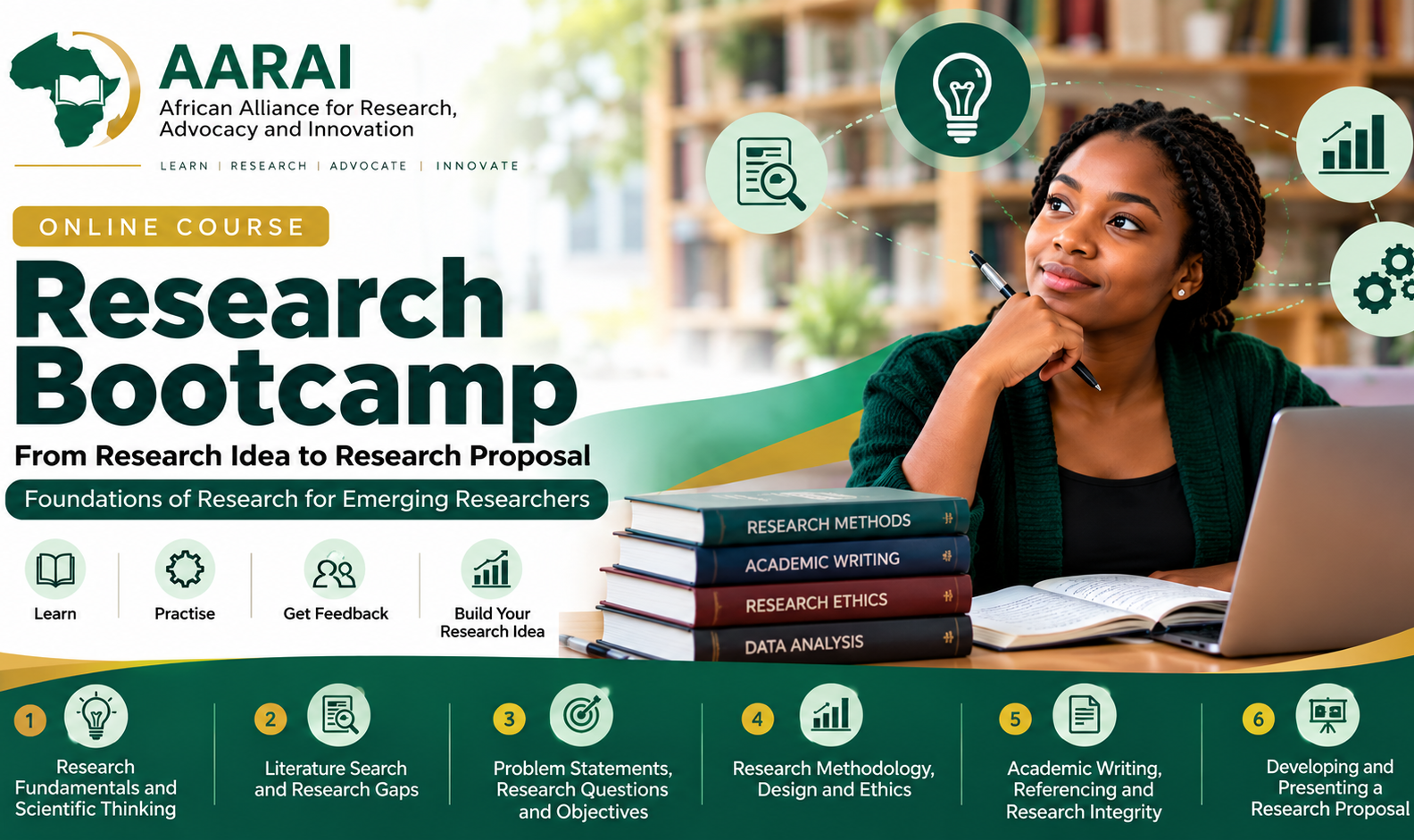
Research Bootcamp: From Research Idea to Research Proposal

- 7 Sections
- 38 Lessons
- 20h 30m Duration
Module 1: Research Fundamentals and Scientific Thinking
- Welcome to your course
- Lesson 1: Understanding Research and the Research Process
- Lesson 2: Purposes of Research and Scientific Thinking
- Lesson 3: From a Broad Interest to a Focused Topic
- Lesson 4: Characteristics of a Researchable Topic
- Lesson 5: Assessing Research Feasibility
- Lesson 6: Practical Exercise and Knowledge Check
Module 2: Literature Search and Research Gaps
- Lesson 1: Understanding Literature Reviews and Their Purpose Lesson Description
- Lesson 2: Introduction to Scholarly Search Tools and Research Databases
- Lesson 3: Developing Keywords and Effective Search Strategies
- Lesson 4: Finding, Evaluating, and Selecting Relevant Literature Lesson Description
- Lesson 5: Understanding and Identifying Research Gaps Lesson Description
- Lesson 6: Practical Literature Search Exercise and Knowledge Check
Module 3: From Research Problem to Research Questions, Aim and SMART Objectives
- Lesson 1: Understanding Research Problems and Problem Statements
- Lesson 2: Writing a Clear and Evidence-Based Problem Statement
- Lesson 3: Formulating Clear and Researchable Questions
- Lesson 4: Developing a Research Aim
- Lesson 5: Writing SMART Research Objectives
- Lesson 6: Aligning Problems, Questions, Aims and Objectives: Practical Exercise and Knowledge Check
Module 4: Choosing the Right Research Methodology
- Lesson 1: Understanding Research Methodology and Research Design
- Lesson 2: Quantitative Research Approaches and Designs
- Lesson 3: Qualitative Research Approaches and Designs
- Lesson 4: Mixed-Methods Research and Choosing an Appropriate Approach
- Lesson 5: Population, Sampling and Data Collection Methods
- Lesson 6: Selecting and Justifying Your Methodology: Practical Exercise and Knowledge Check
Module 5: Academic Writing, Referencing and Research Integrity
- Lesson 1: Foundations of Academic Writing
- Lesson 2: Using Scholarly Sources and Synthesising Literature
- Lesson 3: In-Text Citations and Reference Lists
- Lesson 4: Plagiarism, Paraphrasing and Responsible Use of Sources
- Lesson 5: Research Integrity, AI Tools and Ethical Scholarship
- Lesson 6: Practical Academic Writing Exercise and Knowledge Check
Module 6: Structuring a Research Proposal and Presenting Your Idea
- Lesson 1: Understanding the Structure of a Research Proposal
- Lesson 2: Developing the Background, Problem Statement and Rationale
- Lesson 3: Aligning the Research Problem, Questions, Aim and Objectives
- Lesson 4: Planning the Methodology and Data Analysis
- Lesson 5: Expected Contribution, Impact and Feasibility
- Lesson 6: Developing and Presenting a Short Research Pitch
Module 7: Capstone Project
Research Bootcamp: From Research Idea to Research Proposal
Foundations of Research for Emerging Researchers
Offered by: African Alliance for Research, Advocacy and Innovation (AARAI)
Tagline: Learn. Practise. Get Feedback. Build Your Research Idea.
About the Course
The AARAI Research Bootcamp is a practical, beginner-friendly research training programme designed to help students, emerging researchers, early-career academics, health professionals, and other interested practitioners develop the foundational skills needed to move from a broad area of interest to a clear and structured research proposal.
Many aspiring researchers have promising ideas but struggle to narrow their topics, identify relevant literature, formulate research problems, develop research questions and objectives, select appropriate methods, and organise their ideas into a coherent proposal. This bootcamp addresses these challenges through a structured learning experience that combines foundational knowledge, practical exercises, guided reflection, and research development activities.
Under the theme “From Research Idea to Research Proposal,” participants will be introduced to the essential stages of the research process and guided through the development of a preliminary research concept note or proposal outline. The course emphasises clarity of thought, methodological alignment, ethical responsibility, academic integrity, and the practical application of research knowledge.
The programme is designed for learners who are beginning their research journey or who need to strengthen their understanding of research fundamentals before undertaking more advanced academic or professional research.
What You Will Learn
By the end of this course, you should be able to:
-
Explain the major stages and purposes of the research process.
-
Refine a broad area of interest into a focused and researchable topic.
-
Search for, identify, and evaluate relevant scholarly literature.
-
Recognise preliminary research gaps and explain their significance.
-
Develop a clear research problem, aim, objectives, and research questions.
-
Distinguish between quantitative, qualitative, and mixed-methods approaches.
-
Outline an appropriate research design, sampling approach, data collection strategy, and analysis plan.
-
Recognise fundamental ethical considerations in research involving people and sensitive information.
-
Apply basic principles of academic writing, referencing, and research integrity.
-
Prepare and briefly present a preliminary research concept note or proposal outline.
Course Modules
Module 1: Research Fundamentals and Scientific Thinking
Understand what research is, why it matters, the different purposes of research, and how scientific thinking supports systematic inquiry. Learn how to narrow a broad interest into a focused, feasible, and researchable topic.
Module 2: Literature Search and Research Gaps
Learn how to search for scholarly information, use effective search terms and Boolean operators, evaluate sources, read research papers strategically, organise literature, and identify preliminary gaps that may justify further investigation.
Module 3: Problem Statements, Research Questions and Objectives
Develop the skills to describe a research problem, explain why it matters, formulate a research aim, write specific objectives, and construct research questions that align with the problem being investigated.
Module 4: Research Methodology, Design and Ethics
Explore quantitative, qualitative, and mixed-methods approaches. Examine the relationship between research questions and research design, with an introduction to sampling, data collection, analysis planning, ethical principles, and research approval requirements.
Module 5: Academic Writing, Referencing and Research Integrity
Develop foundational academic writing skills, learn the importance of accurate citation and referencing, explore reference-management tools, and understand plagiarism, responsible use of artificial intelligence, and ethical research communication.
Module 6: Developing and Presenting a Research Proposal
Bring the learning together by developing a preliminary research concept note or proposal outline. Organise the key components of a research proposal, review the alignment between the problem, objectives, and methods, and prepare to communicate the proposed study clearly.
Who Should Enrol?
This course is suitable for:
-
Undergraduate and postgraduate students beginning research projects.
-
Emerging researchers who want to strengthen their research foundations.
-
Early-career academics and lecturers.
-
Health professionals and practitioners interested in evidence-informed practice.
-
Professionals seeking to develop research skills for programme planning, evaluation, policy, or practice.
-
Individuals who have a research idea but need guidance to turn it into a structured concept.
No advanced research experience is required. A willingness to learn, practise, reflect, and improve is essential.
How the Course Works
The bootcamp follows a practical learning cycle:
Learn → Practise → Apply → Receive Feedback → Improve
Each module introduces key concepts and connects them to practical research tasks. Participants are encouraged to work progressively on a research idea of their choice, allowing them to apply the lessons to a topic relevant to their academic, professional, or community interests.
Learning activities may include guided worksheets, topic-refinement exercises, literature-search practice, research-question development, methodological planning, knowledge checks, and proposal-development tasks.
The aim is not simply to introduce research terminology but to help participants begin using research skills in practice.
Expected Course Output
By the end of the bootcamp, participants should have developed a preliminary research concept note or proposal outline based on an area of interest. This will provide a foundation for further refinement, discussion with a supervisor or mentor, and development into a more complete research proposal.
The final output is a starting point rather than a guarantee of a submission-ready dissertation, thesis, grant application, or publication manuscript. Further development may require discipline-specific guidance, institutional requirements, access to relevant data, and additional methodological preparation.
Our Approach to Research
AARAI promotes research that is thoughtful, rigorous, ethical, relevant, and responsive to real-world needs. Throughout this course, participants are encouraged to approach research with intellectual curiosity, respect for evidence, openness to critical feedback, and a commitment to academic integrity.
Artificial intelligence and digital research tools may support learning and research organisation, but they must be used responsibly. They do not replace critical thinking, verification of sources, original scholarly judgement, or compliance with institutional research policies.
Join the Learning Journey
You do not need to have a perfSix structured modules covering the research process from idea to proposal
-
Learn to develop focused, feasible, and researchable topics
-
Master literature searching and preliminary research gap identification
-
Develop research problems, questions, aims, and objectives
-
Understand research designs, sampling, data collection, and ethics
-
Strengthen academic writing, referencing, and research integrity
-
Practise using digital research tools and responsible AI
-
Complete a preliminary research concept note or proposal outline
-
Practical worksheets, guided exercises, and knowledge checks
-
Suitable for beginners, students, emerging researchers, and professionalsect research idea before you begin. You need a question worth exploring, a willingness to learn, and the commitment to improve your thinking step by step.
Join the AARAI Research Bootcamp and begin turning your research interest into a clearer, more focused, and methodologically informed research concept.
African Alliance for Research, Advocacy and Innovation (AARAI)
Advancing Knowledge. Transforming Lives.
Want to submit a review? Login
Related Courses

Practical Research Data Analysis Using IBM SPSS Statistics
Beginner-Friendly Learning: Start from the fundamentals and progress step by step, even if you have limited experience with SPSS.
100% Self-Paced Online Course: Learn at your convenience and revisit lessons whenever necessary.
Hands-On SPSS Training: Practise data entry, coding, cleaning, analysis, and interpretation using guided demonstrations.